

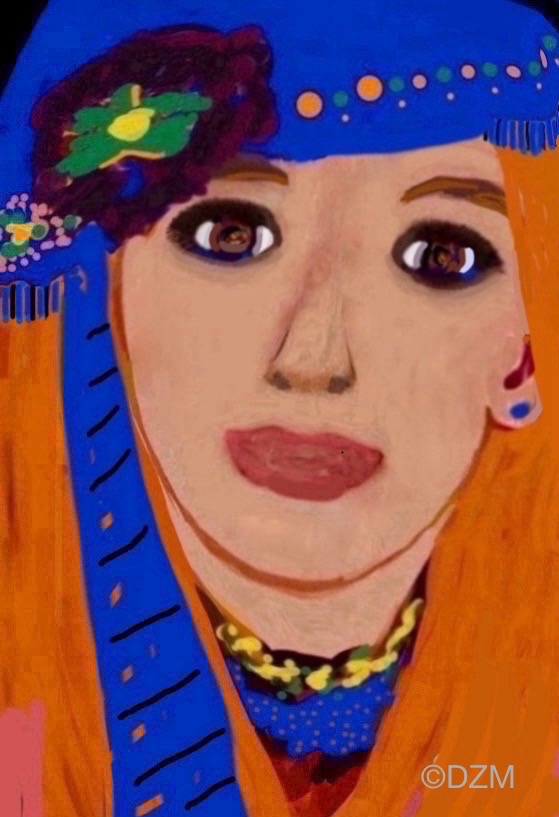
In 1939, Adolf Hitler had decided to invade Poland. France and Great Britain entered the war days later. America entered the war after the Japanese attacked Pearl Harbor in 1941. World War II was a bloody conflict with shocking revelations but there were countless stories of fictitious and real heroes and heroines.
One of those, Dream Girl, is shown in my latest art. She is a Woman of Strength. Dream Girl is a fantastical character, and so is her story, but it was created out of what transpired in that era.
Emilia Wagner gingerly walked through the German forest with her friend on a temperate fall night in 1940. They were delivering baskets of cheese, bread, roasted almonds, apples, grapes, pickles, mustard, jam, elderberry wine, coffee, and sausage.
Along with the food baskets, there were other essentials they were taking to three families. The families were all living in a large converted barn, made from Red Oak and Beech trees, on a former college professor’s estate. It was on a remote farm in the mystic geographically rich forests of the Harz Mountains, which are several hours from Berlin.
Essentials included first aid, bullets for hunting and defense, seeds for planting vegetables, batteries, candles, ink, aspirin and antibiotics, and small allotments of money to get to possible codebreakers — this was before the codebreaking success of Great Britain’s Alan Turing — who were working to decipher German Enigma machine messages (an encryption device that looked like a typewriter). Germans had deciphered Morse Code to read the allies’ messages and the allies were working endlessly to understand Germany’s military plans. [An English mathematician, computer scientist, cryptanalyst, and logician, Alan Turing was key to the evolution of theoretical computer science.]
“Keep going,” Emilia whispered to her companion. “We’re not far from them now.” They could smell the rich soil and the spruce trees. They could feel their destination was close. They stopped for a few minutes to arrange their shawls and pin up their hair and hats.
Emilia was tired but, now, this was how she made a difference for her country and future generations.
In World War II, information and communication were as powerful as the earthly need for trees, the sun and rain. Their rays and roots promised a tomorrow.
Activists against Hitler knew that if he was a dictator without propaganda and inflammatory and racist speech to feed to the masses, he would not have been able to rule Germany the way he did. The ground beneath him would have buckled.
Hitler promised Germans a better future and economy and then went on to select, demonize, and murder millions of people.
Ravaged by World War I, Germans were susceptible to Hitler’s nationalistic policies. They indeed sang, danced and drank in beer halls, but their lives were hard.
Chancellor Hitler’s language and ideas took hold, fermented, and changed the world forever, eventually bolstering Russia while Germans, Jews, Italians and the Japanese faced extreme hardships as did American soldiers fighting overseas.
But Emilia could not just think about this reality day in and day out. So she sojourned, to get goods to former writers and members of the disenfranchised press, along city roads and country trails that resembled black sapphires in the silvery night. Lights in windows communicated messages to let her know when and if they could make the deliveries. It was rote by now.
For most of her years, Emilia, now 28, had been a fiery redhead who loved hats, animals, hiking, Mozart, and fulfilling her dream of working as a copy editor at a small newspaper. Then Hitler shuttered the press, closed down operations, and threatened and jailed workers.
Now, with the help of trusted comrades, Emilia and her cousin Catrine were traveling to the hidden farm with the help of a network of people pushing against the Hitler regime. They were unassuming with their smart clothes and pretty faces. Via train, with known middlemen in sedans, and sometimes partially on horse-led trails, they made their way to help former journalists survive so the latter could produce underground pamphlets and get news out about what was happening in Germany.
When Hitler’s hate indelibly changed the world for the worst in the 1930s, one of the first legs of democratic freedom — free speech and a free press — was broken, and never splinted, by the Nazi Party. Hitler’s targets were definitively Jews but also other humans he denounced as inferior (gay men, those with disabilities, people he labeled communists, Slavics, blacks and artists).
Berlin then was a bustling city known for its shops, businesses, art venues, architecture, restaurants, clubs, musicians, wordsmiths, historic sites, and parks.
Hitler, however, was threatened by the city’s avant-garde energy and mood. So one way he sought control was to disenfranchise those drawn to Berlin, including writers, artists and vagabonds.
He also monopolized radio, printing presses, the creation of newsreels, affected the people’s power to understand the workings of government, and squelched the writings and books the Nazis did not like. When it became widely known that books were being destroyed, a contingency of Germans worked to save manuscripts. They would zipper them up in leather backpacks and store them under the floorboards in attics.
Throughout Germany and regions where people were allied with the free world, there was unquestionably a growing and secret base of both non-violent as well as armed citizens who sought an end to Hitler’s monstrous political and cultural goals.
Emilia was involved in what might be seen as passive resistance. There were subversive information networks established through which news was disseminated to the BBC, persecuted people were hidden, injured citizens got to doctors, passports were forged for Jewish people, and food was transported to forced laborers.
Emilia had listened very closely to what her father, Hans, had taught her from the day she was first able to visit his students at their private school in Berlin and feel the energy in the room. Whoever thought an old book (that clearly smelled like an old book) and inky newspapers fresh from being printed could stir someone’s soul … but they did for fathers like Hans and daughters like Emilia.
They thought that the secrets of the universe were contained on paper imprinted with black letters and numbers.
Hans and Emilia would occasionally go out to eat after school and have fried pork schnitzels with lemon slices, red cabbage sauerkraut, cucumber and sour-cream salad, buttered spaetzle, lima beans and corn, and chocolate tortes.
Other nights, when he got home early to the family’s Prussian-style apartment in Berlin that Emilia’s grandparents had passed on to their eldest heir, Hans would drink a little brandy and then begin speaking with Emilia. Emilia was homeschooled so she could help with her younger siblings. But when Hans came home, he would inquire about what she had learned that day, what was in the newspapers, how she felt about the local and national news, and then they would listen to the radio while the family had roast chicken or grilled fish with cold salads, stews, vegetable soups, and potato pies followed by fresh fruits. The family cats would wait patiently for morsels on fish nights.
Hans, who taught history, writing and poetry and was fluent in Russian, was fond of talking about German’s long and storied history on these evenings. But he was also, more broadly, a stalwart educator who taught his students about the importance of facts and information being made available to the public.
When the war broke out, the school where Hans worked was ruined — structurally, philosophically and generationally — by the Nazis.
The school had been taken over by the Nazis during the war and so Hans went home to take care of his family. Soon, by force, he was directed to translate Russian documents for the German government. Unannounced, they would drop them off twice a week.
“I can’t believe I have to do this,” Hans often said to his wife Greta. “Somehow I am going to find a way to turn the bad into the good.”
So Hans used that relationship to engender trust with some of the senior officers in the party and he was able to learn about a growing system of journalists and writers who were creating underground news operations, getting information to the foreign press, and circulating news leaflets.
Over the course of months, Hans and Emilia developed a strategic plan, sources, a budget and different routes, and a clandestine network of Germans. These people took risks to ensure that the press and contemporary literature, with free ideas, would hopefully prevail.
Emilia and Hans passed away decades later, just eight years apart, but are both memorialized near structures that were restored on the professor’s farm and are buried in a cemetery of non-violent resisters who took on the Nazi regime.
They are known as members of the Knowledge Keepers of World War II. In 2006, Harz became the first National Park in Germany to cover two federal states.
Leave a Reply